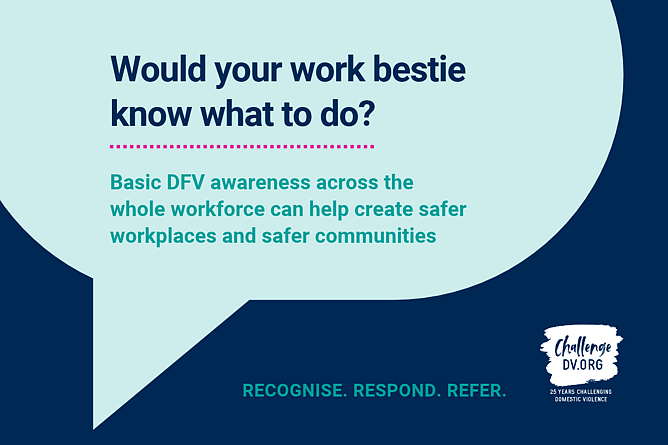
We spend a lot of our lives with the people we work with.
They know our coffee order. They know when we've had a bad day. They notice when we're quieter than usual, distracted, or when something just doesn't seem right.
Some become friends. Some become our work besties.
And sometimes, they're the person we choose to talk to when something is wrong.
“Can I tell you something?”
If a colleague told you they weren't safe at home, what would you do?
Most of us would want to help.
But wanting to help and knowing how to respond safely aren't always the same thing.
And that's where I think we have an opportunity.
We don't need everyone to be an expert
When we talk about workplace responses to domestic and family violence, the focus can naturally turn to HR, People and Culture and leaders.
Of course, those people need the right capability.
But what about everyone else?
The colleague sitting beside you.
The person you have lunch with.
The work mate who notices something has changed.
Because sometimes difficult conversations happen simply because one person trusts another.
We shouldn't expect that colleague to become a counsellor or DFV specialist.
But we can give them enough understanding to know what to do next.
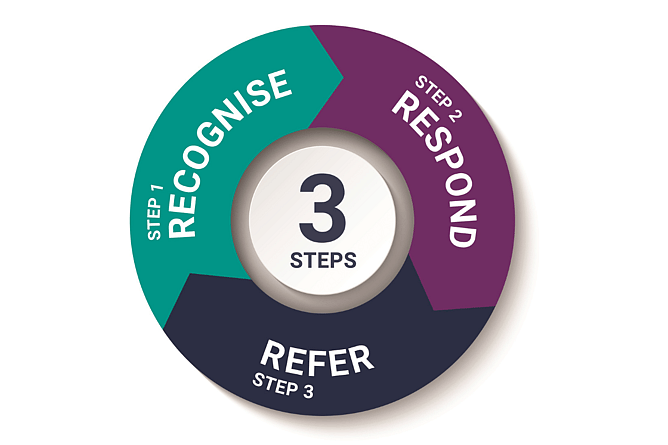
Recognise. Respond. Refer.
That's the power of a simple framework.
It's something people can remember when they suddenly find themselves having a conversation they weren't expecting.
Recognise:
Notice when something might not be right.
You don't need to diagnose someone's situation or make assumptions.
Awareness simply helps us recognise that domestic and family violence can take many forms and its impacts don't necessarily stop when someone arrives at work.
Respond:
This is where our natural instinct to help needs to be matched with some knowledge.
Listen.
Don't judge.
Don't try to investigate or fix everything.
And understand the boundaries of your role.
Sometimes we don't need the perfect words. We just need to make sure the person feels heard, respected and supported.
Refer:
It's importantly to know where to go next.
Being a supportive colleague doesn't mean taking responsibility for someone's situation.
It means knowing how to connect them with the appropriate internal or specialist support.
You don't need to have all the answers. You just need to know where the answers can be found.
That’s why I think whole-of-workforce awareness is so important.
Challenge DV's Workplace Response and Prevention to Domestic and Family Violence eLearning gives people a basic understanding of how to Recognise, Respond and Refer.
It's not about having all the answers. It's about building the confidence to know what to do next.
What a safe workplace looks like to me
✓ Policies
✓ Clear processes
✓ Trained leaders
✓ Specialist support
→ But I don't think we create safer workplaces through policies and procedures alone.
Safer workplaces are created through our people
Through the culture we build.
Through the conversations we make possible.
And through making sure people feel a little more confident about what to do when somebody turns to them.
Safe Work Australia recognises that family and domestic violence can become a work health and safety issue when it creates risks to workers' health and safety at work. [safeworkaustralia.gov.au], [safeworkaustralia.gov.au]
Australian research examining organisational responses to domestic and family violence has identified co-worker support, alongside education and training, manager support, confidentiality and clear referral pathways, as part of an effective organisational response. [anrows.intersearch.com.au]
That evidence matters.
But for me, the practical question is much simpler:
If someone in your workplace turned to a colleague tomorrow and said, “I need to tell you something,” would they know what to do next?
Most of us would want to help. But knowing how to respond safely can make all the difference
Whole-of-workforce DFV awareness isn't about making everyone responsible for responding to domestic and family violence.
It's about giving people a shared foundation.
To recognise.
To respond appropriately.
And to refer to the right support.
Because when someone chooses to talk, the first response they receive matters.
And perhaps that's one of the simplest places we can start when we're talking about creating safer workplaces and safer communities.
Ready to take action?
Challenge DV offers programs and services that ensure your organisation is not just compliant, but truly equipped.
Get a quick training quote or contact me, Lizzy Edwards, Corporate Solutions Manager, to find out how we can work together: lizzy@challengedv.org
Article References:
Safe Work Australia. Family and domestic violence at work. Guidance on managing family and domestic violence as a workplace health and safety issue. [safeworkaustralia.gov.au], [safeworkaustralia.gov.au]
Our Watch. Workplace Equality and Respect. An evidence-based approach to supporting organisations to promote gender equality and prevent gender-based violence. [ourwatch.org.au], [ourwatch.org.au]
ANROWS. Voices from the frontline: Qualitative perspectives of the workforce on transforming responses to domestic, family and sexual violence. [anrows.org.au], [anrows.org.au]
Australian Human Rights Commission. Domestic and family violence: a workplace issue, a discrimination issue. [humanrights.gov.au]